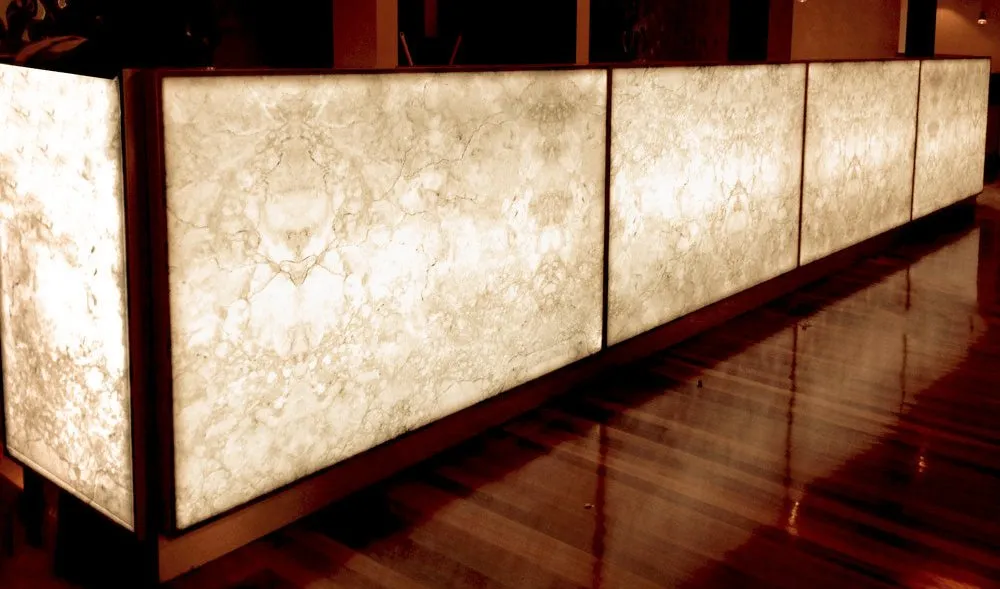
When decoratively lit, translucent stone can be an eye-catching design element. Onyx and other natural or manufactured stones can conduct light and display patterns that are difficult to notice under normal lighting. As well as the stone, the quality of the backlighting system is crucial. The essential components of a good LED sheet include even illumination, space-saving design, efficient heat dissipation, and the ability to achieve the desired look of the show.
Understand the Stone First
Look at the nature of the stone, its thickness, its transparency, its color and its pattern before choosing the lighting system. Different slabs are able to transmit different amounts of light. Brightness will vary from area to area, depending on the structure of the material.
LED sheet for Backlighting Stone will be the widespread source of light behind the translucent surface. This can be helpful if there were individual LED points in the background, creating a bright spot.
The distance between the lighting surface and stone should also be taken into account. The lighting may need to be different for a thicker block, so the entire assembly should be tested prior to installation.
Consider Light Uniformity
One of the most difficult problems in the field of backlighted architectural surfaces is uniformity. If the individual LEDs are too visible, patches or concentrated areas of brightness may be apparent in the finished stone.
LED sheets illuminate over a wider area to provide a more uniform look. This may be helpful in the design of countertops, feature walls, reception desks, partitions and decorative panels.
Find products that are specifically made for use in backlighting instead of using regular LED strips without taking into account the spacing. The aim is to ensure the stone surface is evenly lit from the front.
Choose the Right Brightness
The desired output will be determined by the stone and the visual effect desired. If the installation is a decorative feature, it will be sufficient to light it with a small power, and if the installation is for a large commercial space, it will need more power output.
The brightness should be judged in conjunction with the transparency of the stone. Don’t always get what you want just because you’re making a lot. May cause some areas to look too bright or may make the natural pattern look unbalanced.
It’s possible to test a small sample of the stone with the proposed LED sheet to see if the brightness and distribution are the correct ones before ordering the complete sheet.
Lighting Onyx Surfaces
For backlit applications, onyx is especially sought after for its natural translucency, as well as the presence of patterns. Properly illuminated, its color, veins and layers can be more pronounced.
An LED Light Sheet for Onyx should uniformly and evenly illuminate a large area without hot spots. The lighting system should also be installed behind the stone, but not affect the supporting system.
Testing is particularly worthwhile as each slab of onyx will have a different look. A successful illumination for one slab might not work with another variety or thickness.
Think About Installation Space
The type of lighting system chosen may depend on the available depth. In certain projects, the space between the stone and supporting surface can be very restricted.
Be sure to measure the cavity before you select the sheet. Take into account the thickness of the lighting product, space to run the wiring, installation type and access for maintenance.
The supporting surface should also be clean and appropriate for the type of installation. When using large sheets, it is important to take the time to position the sheet so that there are no gaps or overlaps.
Plan Electrical Requirements
Electrical planning is still needed for LED sheets. Before choosing the power supply, be sure to verify the operating voltage, power consumption and total surface area.
If a large installation is needed, several sections and/or separate power connections may be necessary. The wiring should be designed to provide steady power to the complete installation of lighting.
Controls should also be taken into consideration. If the feature has to operate in various environments, or at different times of day, then dimming can be helpful. This could mean that a restaurant, hotel or residential area might need a different amount of light at night than during the day.
Consider Heat Management
While LED sheets are efficient, bigger sheets of light can cause heat. The lighting system’s installation design should provide for the system to function within the conditions for which it was designed.
When planning the assembly, the backing surface and surrounding materials and ventilation should be taken into account. It is important to review product specifications for recommended mounting conditions.
Do not assume based only on the size and/or look of the sheet. When the installation is planned properly with regard to electric and thermal aspects, it is more reliable.
Conclusion
The only way to really assess backlighting is to test the stone, lighting sheet and mounting combination. This enables the designer and installer to verify brightness, uniformity, color temperature, shadows and visible differences. A sample test can also be used to verify if adjustment of spacing or mounting is required prior to fabrication. This is very useful for custom built-in elements such as those that cannot be changed after installation. Lighting can be designed to highlight stone rather than fit it into a pre-designed light fixture, and can achieve an elegant architectural effect. Richeilighting.com can be a reliable resource for professionals to go through the lighting products and components and find lighting solutions for special projects that suit LED.